Automatic Screening for Diabetic Retinopathy Severity
Deep learning models for grading diabetic retinopathy severity from retinal fundus images, built on EfficientNet.
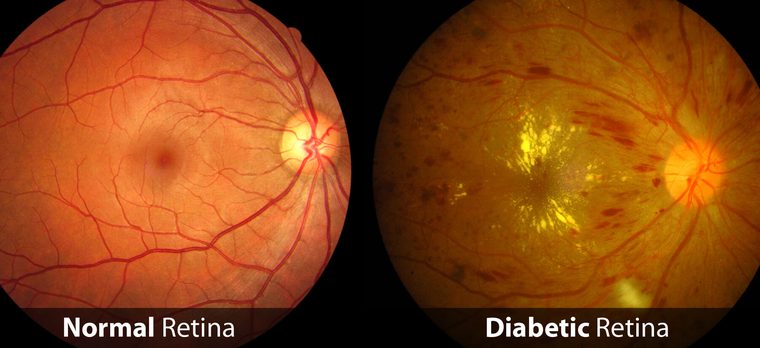
Diabetic retinopathy is a leading cause of preventable blindness, and screening at scale is limited by the number of clinicians available to read retinal images — a manual read that is also poorly reproducible between readers. Automatic severity grading offers a way to triage.
The hard version is the five-class problem — no DR, mild, moderate, severe, proliferative. Most published work at the time either collapsed it to two or three classes, or reached about 75% on five.
What made the difference
Preprocessing, more than architecture. The Kaggle dataset is a real screening archive with wildly varying image quality. Applying contrast-limited adaptive histogram equalisation to the green channel only beat applying it to all three — green carries most of the retinal vasculature contrast and the other channels mostly contribute noise. Adding a centre crop to the retina itself pushed validation accuracy from 64.65% to 67.60% in the preliminary comparison.
Progressive resizing. Train at 256 × 256, then continue at 512 × 512. This lifted EfficientNet-B4 by 3.47 percentage points of accuracy against single-size training, and B5 by 1.07 — notably, it helped the smaller model more.
Focal loss, because 25,810 of roughly 35,000 images are class 0.
Results
| Model | QWK | Weighted F1 | Accuracy |
|---|---|---|---|
| Progressive EfficientNet-B4 | 0.7922 | 0.8269 | 83.87% |
| Progressive EfficientNet-B5 | 0.7931 | 0.8265 | 83.89% |
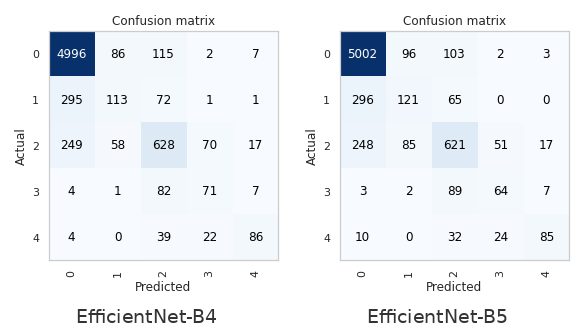
B5 did not beat B4 despite 1.58× the parameters, which suggests it is simply overparameterised for this dataset. At 83.89% on five-class grading, both sit well above the ~75% previously reported with larger architectures.
Carried out at the Biomedical Research Group, Bandung Institute of Technology, and published at IEEE TENCON 2020.
Publications from this project
IEEE Region 10 Conference (TENCON), 2020
Automatic Diabetic Retinopathy Classification with EfficientNet
pp. 756–760.
@inproceedings{lazuardi2020automatic,
  title     = {Automatic diabetic retinopathy classification with EfficientNet},
  author    = {Lazuardi, Rachmadio Noval and Abiwinanda, Nyoman and Suryawan, Tafwida Hesaputra and Hanif, Muhammad and Handayani, Astri},
  booktitle = {2020 IEEE Region 10 Conference (TENCON)},
  pages     = {756--760},
  year      = {2020},
  publisher = {IEEE}
}