IEEE Region 10 Conference (TENCON), 2020
Automatic Diabetic Retinopathy Classification with EfficientNet
pp. 756–760.
Part of Automatic Screening for Diabetic Retinopathy Severity
@inproceedings{lazuardi2020automatic,
  title     = {Automatic diabetic retinopathy classification with EfficientNet},
  author    = {Lazuardi, Rachmadio Noval and Abiwinanda, Nyoman and Suryawan, Tafwida Hesaputra and Hanif, Muhammad and Handayani, Astri},
  booktitle = {2020 IEEE Region 10 Conference (TENCON)},
  pages     = {756--760},
  year      = {2020},
  publisher = {IEEE}
}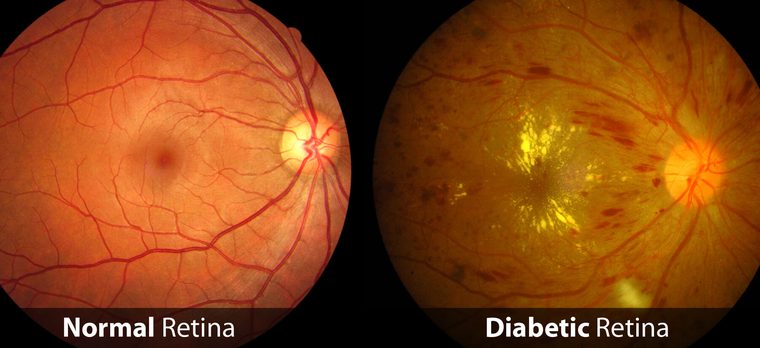
Diabetic retinopathy is a leading cause of blindness in adults, and screening for it means an ophthalmologist reading fundus photographs one at a time — slow, and poorly reproducible between readers. Automating the grading is attractive for exactly that reason.
The hard version of the task is the five-class one: no DR, mild, moderate, severe, proliferative. Most published work at the time either collapsed it to two or three classes or topped out around 75% accuracy on five.
Approach
EfficientNet as the backbone, B4 and B5, pretrained on ImageNet and fine-tuned. The choice is about parameter efficiency — compound scaling gets high accuracy without the parameter count of the architectures earlier work had reached for.
Preprocessing matters more than it looks. The Kaggle dataset is a real screening archive, with wildly varying image quality. Contrast-limited adaptive histogram equalisation was tested on each colour channel separately:
| CLAHE channel | Train | Validation |
|---|---|---|
| R | 67.98% | 63.60% |
| G | 68.40% | 64.65% |
| B | 67.64% | 64.70% |
| R+G+B | 67.94% | 63.90% |
| G + centre crop | 71.50% | 67.60% |
Equalising only the green channel beats equalising all three — green carries most of the retinal vasculature contrast, and the other two mostly add noise. Cropping to the retina itself adds another few points.
Progressive resizing: train at 256 × 256 first, then continue at 512 × 512, 100 epochs total, with focal loss to cope with a dataset where 25,810 of ~35,000 images are class 0.
Results
| Model | QWK | Weighted F1 | Accuracy |
|---|---|---|---|
| Progressive EfficientNet-B4 | 0.7922 | 0.8269 | 83.87% |
| Progressive EfficientNet-B5 | 0.7931 | 0.8265 | 83.89% |
Accuracy alone would be misleading on a dataset this imbalanced, so quadratic weighted kappa is the headline metric — it also has the right shape for the problem, since grading errors between adjacent severities matter less than errors across the whole scale.
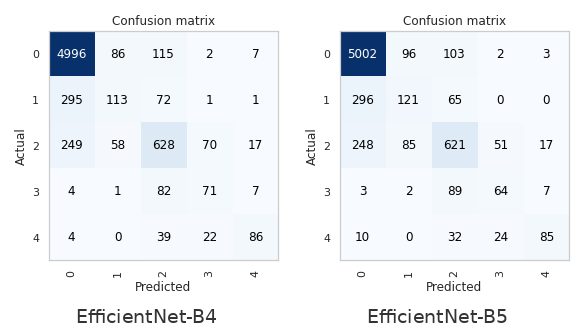
Two results worth keeping:
Progressive resizing helped, and helped the smaller model more — +3.47% accuracy on B4 against +1.07% on B5, compared with training at one image size.
B5 did not beat B4, despite 1.58× the parameters, which suggests B5 is simply overparameterised for this dataset. Bigger was not better here.
At 83.89% on five-class classification, this sits well above the ~75% that Pratt et al. and Lam et al. reported with larger architectures.