Tube-Launched Folding-Wing UAV
A compact fixed-wing UAV that stows in a tube and deploys without a runway, with a coordinated relay system to extend communication range. Best Design, Indonesia Aerial Robotics Competition 2017.

Most fixed-wing UAVs are awkward before they are useful. They fill a vehicle in transport. They need a runway or a dedicated launcher that has to be carried in, set up and taken down. And assembling one on site costs time you may not have — which in difficult terrain is the whole problem.
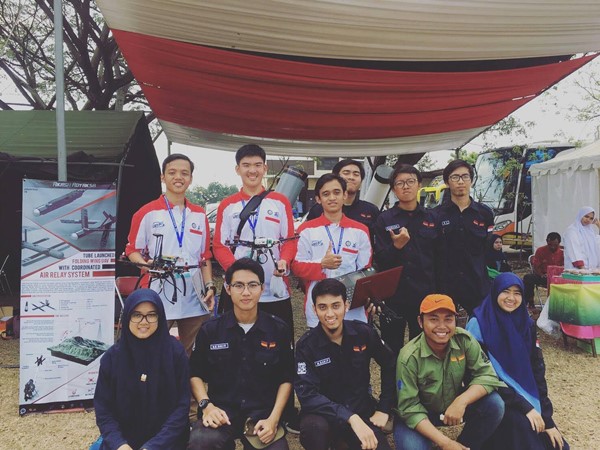
Built for the Indonesia National Aerial Robotics Competition 2017, this was one of Indonesia’s first autonomous folding-wing UAVs. It took Best Design and 1st Runner-Up.
The idea
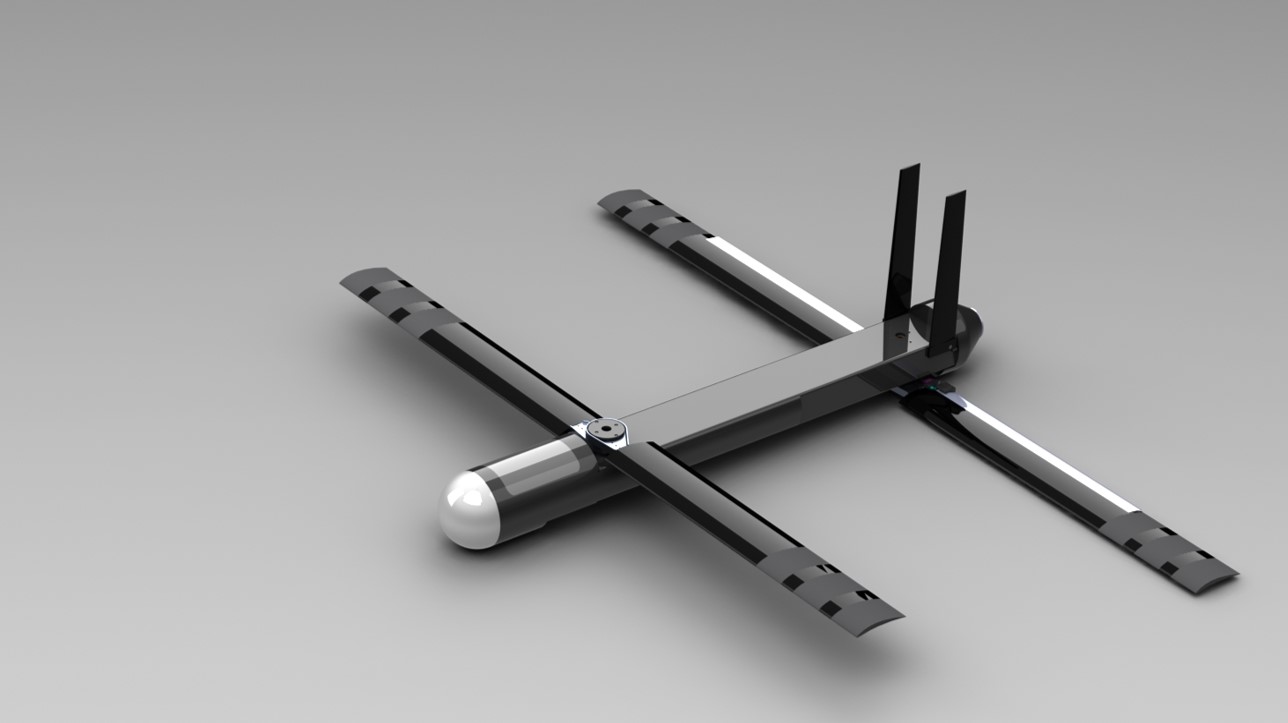
Make the aircraft fit in a tube and fly straight out of it.
A tandem wing is what makes that possible — it buys lifting surface without any single long span, so the whole aircraft collapses into a cylinder roughly 5 inches across. Torsional springs deploy the wings on exit, and the aircraft transitions to autonomous flight at about 25 m/s.
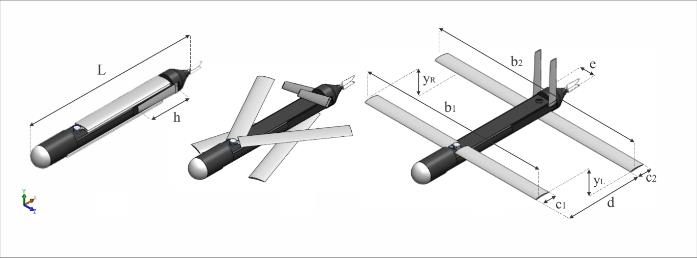
Multiple aircraft can be launched at once from a pneumatic launcher, with no runway anywhere in the process. A coordinated relay system extends communication range by using the aircraft themselves as relays — the limitation that bites hardest in hilly terrain.

My part
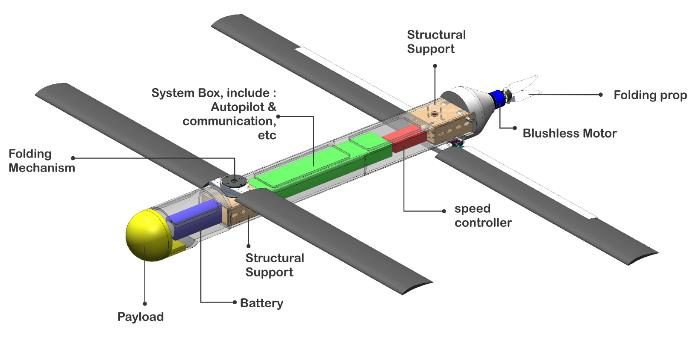
I built the avionics system — a Pixhawk flight controller on a 4S 6200 mAh LiPo, brushless DC propulsion, and two separate radio links so flight data and pilot command never contend. Power distribution between the autopilot and the actuators is deliberately split, keeping back-EMF from the servos off the flight controller.
Flight testing
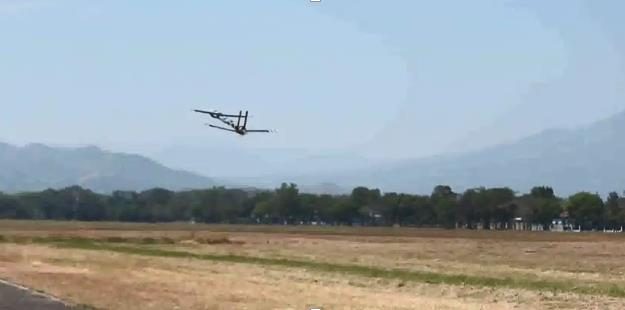
From the flight controller logs: 100 km/h maximum airspeed, 150 m/min climb rate, roughly 45 km/h stall at 3 kg, about 160 m maximum relative altitude, and a longest autonomous flight of 26 minutes.
Autonomous mode flew badly at first — the guidance was unstable. The logs showed target bearing and actual nav bearing diverging sharply, because the aircraft is far more agile than the stock navigation parameters assume. Retuning them fixed it. The unconventional configuration caused the problem and the flight data is what made it visible.
Video
Related reading
Rosid, N. H., Lukman, E. I., Fadlillah, M. A., & Moelyadi, M. A. (2018). Aerodynamic Characteristics of Tube-Launched Tandem Wing Unmanned Aerial Vehicle. Journal of Physics: Conference Series, 1005(1), 012015. IOPscience
Publications from this project
International Conference on Intelligent Unmanned Systems (ICIUS), 2018
Design and Development of Tube-Launched Unmanned Aerial Vehicle
@inproceedings{muzammil2018design,
  title     = {Design and Development of Tube-Launched Unmanned Aerial Vehicle},
  author    = {Muzammil, Ahmad Fadlillah and Rosid, Nurhayyan Halim and Hanif, Muhammad and Fadel, Naufalino and Moelyadi, M. Agoes and Budiyono, Agus},
  booktitle = {International Conference on Intelligent Unmanned Systems (ICIUS)},
  year      = {2018}
}