International Conference on Intelligent Unmanned Systems (ICIUS), 2018
Design and Development of Tube-Launched Unmanned Aerial Vehicle
Part of Tube-Launched Folding-Wing UAV
@inproceedings{muzammil2018design,
  title     = {Design and Development of Tube-Launched Unmanned Aerial Vehicle},
  author    = {Muzammil, Ahmad Fadlillah and Rosid, Nurhayyan Halim and Hanif, Muhammad and Fadel, Naufalino and Moelyadi, M. Agoes and Budiyono, Agus},
  booktitle = {International Conference on Intelligent Unmanned Systems (ICIUS)},
  year      = {2018}
}
Most fixed-wing UAVs are awkward before they are useful. They take up space in transport, they need a runway or a dedicated launcher that has to be set up and taken down on site, and assembling one costs time you may not have.
The premise here: make the aircraft fit in a 5-inch tube and fly straight out of it.
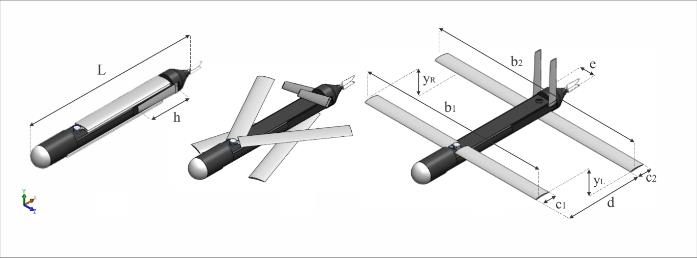
Launched from a pneumatic tube, the wings deploy under torsional springs and the aircraft transitions to autonomous flight at roughly 25 m/s.
Design
| Configuration | Tandem wing, folding |
| MTOW | 4 kg |
| Wingspan | 1.508 m (wing), 1.318 m (canard) |
| Cruise speed | 25 m/s |
| Operating altitude | 60–200 m |
| Endurance | up to 30 min |
| Airfoil | NACA 8408 (wing and canard), NACA 0010 (vertical stabiliser) |
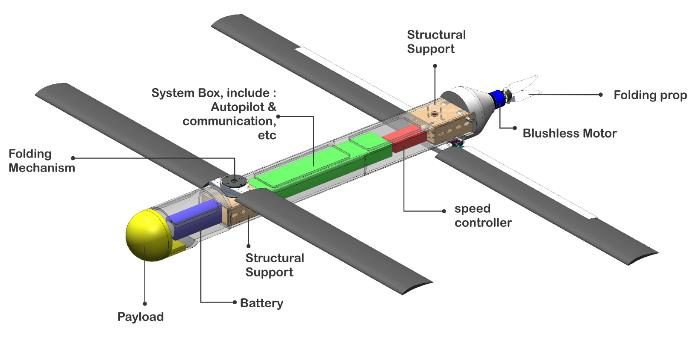
The airframe combines CFRP wings, GFRP fuselage and tail, aluminium spars and folding mechanism, and high-density foam to hold the shape. Airframe alone is half the weight budget; avionics take another quarter.
Analysis
Stability was estimated in XFLR5, and the root-locus analysis shows the aircraft stable in both longitudinal and lateral modes — two dutch roll modes, roll damping and spiral laterally; phugoid and short-period longitudinally. Aerodynamic characteristics came from ANSYS CFX, solving RANS to get the lift curve and drag polar.
Avionics are built on a Pixhawk flight controller with a 4S 6200 mAh LiPo, brushless DC propulsion, and two separate radio frequencies for flight data and pilot command. Power distribution between autopilot and actuators is deliberately split to keep back-EMF off the flight controller.
Flight testing
Measured from the flight controller’s data logs:
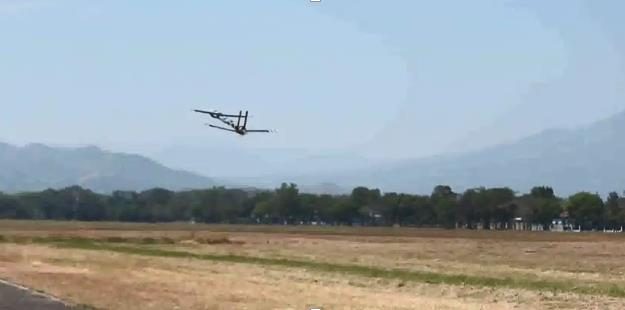
- maximum airspeed 100 km/h
- climb rate up to 150 m/min
- stall speed roughly 45 km/h at 3 kg take-off weight
- maximum relative altitude about 160 m
- longest autonomous flight 26 minutes, from 16.7 V down to 14.8 V
Autonomous mode initially flew badly — guidance was unstable. The logs showed why: the aircraft is agile enough that target bearing and actual nav bearing diverged sharply, which the stock navigation parameters were never tuned for. Retuning them fixed it. The unconventional configuration was the cause, and the flight data was what made it visible.
Built with the Aksantara UAV research group and funded by ITB.