B.Sc. Thesis, Bandung Institute of Technology, 2018
Design and Implementation of Control System in Hybrid Underwater Glider Vehicle in ROS Environment
Department of Electrical Engineering. Advisors: Prof. Bambang Riyanto and Dr. Egi Hidayat.

Indonesia is 64.85% ocean by area, and much of that territory goes unsurveyed because sustained data collection at depth is slow, expensive and risky for people. A vehicle that can both loiter efficiently and manoeuvre on demand is the useful shape for that problem — which is what the Hybrid Underwater Glider (HUG) “Arnadyaksa”, developed by the LSKK research group at ITB, is built to be. It combines the two modes of underwater travel usually treated separately: AUV thruster propulsion, responsive but power-hungry, and glider buoyancy-driven motion, very efficient but slow.
This thesis designs and implements the control system responsible for the vehicle’s movement and attitude in both modes.
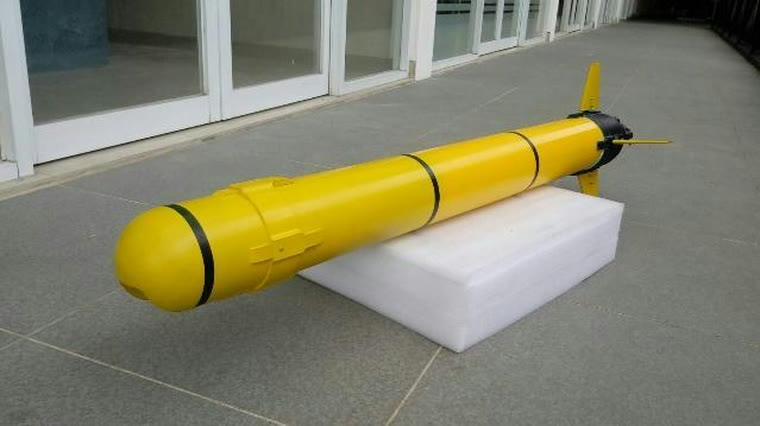
Approach
The control system is built from four controllers — surge, pitch, buoyancy engine, and yaw — on a cascaded PID structure. Pitch and buoyancy control are sequenced by a finite state machine that takes pitch angle and depth as inputs to produce the sawtooth dive-and-climb profile of glider mode; yaw and surge take over the movement mechanism in AUV mode.
Everything runs on ROS on a single-board computer. The buoyancy engine — a linear actuator driving a piston and reservoir, paired with a moving mass for pitch trim — later became the subject of an Indonesian patent.
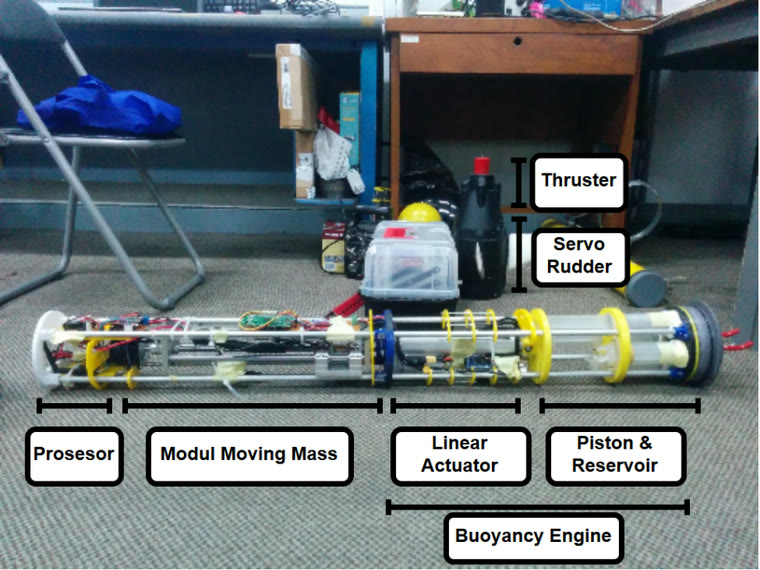
Validation
Testing went in three stages, each closing more of the gap to the real vehicle: software-in-the-loop simulation visualised in RViz, then hardware-in-the-loop (HILS) with the real electronics in the loop, then pool testing of the physical vehicle — buoyancy and pitch trimming, glider-mode dives, and AUV depth holding.
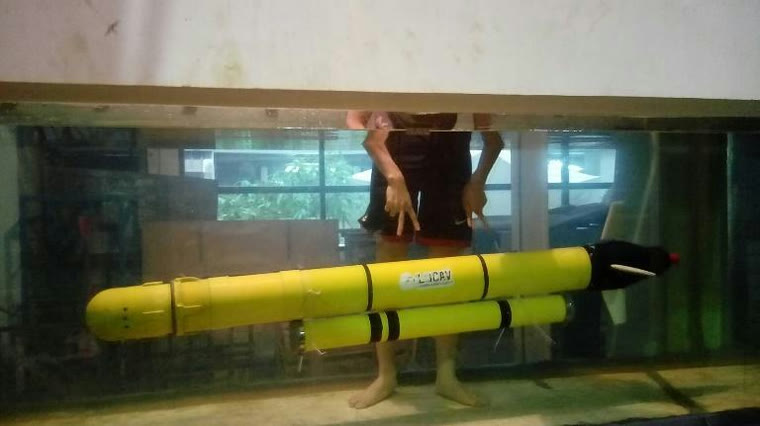
The control system performed the commanded operations across both modes as designed.
Full project detail: Hybrid Autonomous Underwater Glider.