Hybrid Autonomous Underwater Glider
A long-endurance underwater platform combining AUV propulsion with buoyancy-driven glider motion, taken from design through lake testing.
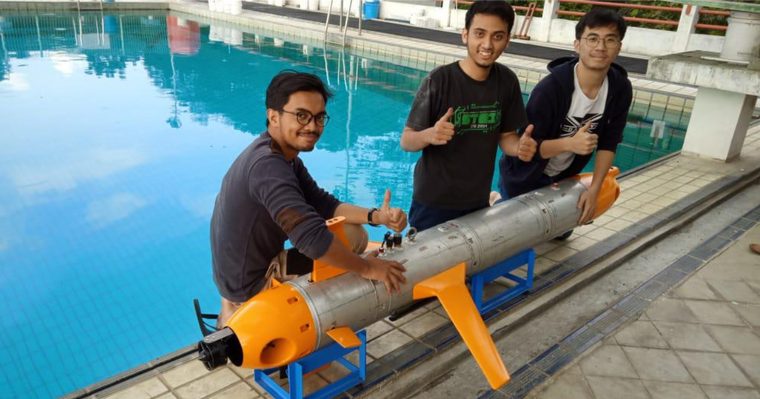
The Hybrid Autonomous Underwater Glider (HAUG) combines two modes of underwater travel. An autonomous underwater vehicle uses thrusters — responsive, but power-hungry. An autonomous underwater glider changes its buoyancy and converts vertical motion into forward glide — very efficient, but slow and weakly controllable. A hybrid vehicle can switch between them depending on what the mission needs.
At the Advanced Robotics Research Laboratory at ITB, I designed and implemented the vehicle’s control system in ROS and led the design team across software, hardware and mechanical iterations, through to lake testing. The buoyancy engine developed for the vehicle — which uses paired internal and external fluid bags driven by a hydraulic pump — is the subject of an Indonesian patent.
This work was also my B.Sc. thesis.
Publications from this project

B.Sc. Thesis, Bandung Institute of Technology, 2018
Design and Implementation of Control System in Hybrid Underwater Glider Vehicle in ROS Environment
Department of Electrical Engineering. Advisors: Prof. Bambang Riyanto and Dr. Egi Hidayat.
Indonesia Patent No. P00202102652, 2021