VR Interface for Drone Swarm Teleoperation
Flying a drone swarm from inside a VR headset, with formation control holding the shape and a control barrier function keeping it safe — and a measurement of what that interface actually costs the operator.

One operator, several drones. The appeal of a head-mounted display here is straightforward — drones move in three dimensions and a tablet screen does not — and a hand-tracked controller should express a 3D velocity command more naturally than a joystick ever could.
This project built that system on real hardware, then measured whether the appeal survives contact with an operator.
The system
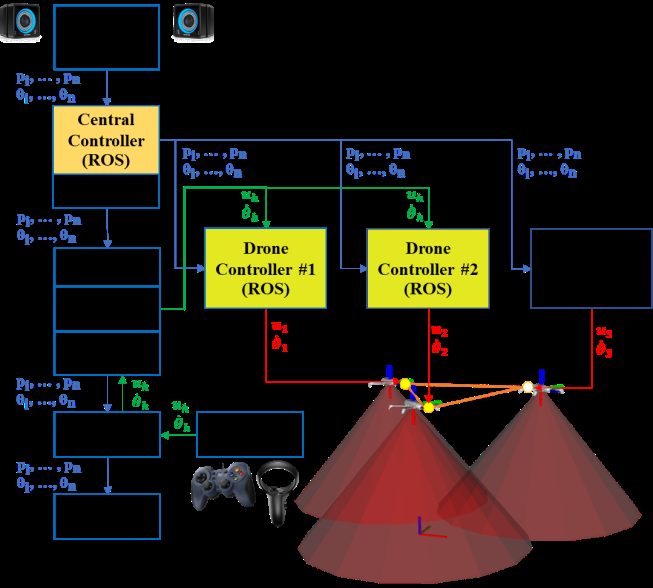
Three drones in a motion-capture room. Motion capture feeds a ROS central controller, ROSBridge and ROS# carry state into Unity, and SteamVR drives an Oculus Rift S while reading whichever input device the operator is holding.
Crucially, the operator can only reach two of the three drones. The third has no direct input and holds its place from its neighbours alone — the realistic case, since an operator may never have had a link to every drone in the swarm, or may lose one mid-flight.
Control
Formation is held by PI-consensus on position and P-consensus on orientation, so the swarm moves as one body under a single velocity command. A control barrier function enforces the safety envelope — no collisions between drones, no leaving the workspace — independently of what the operator asks for.
Common orientation turns out to be load-bearing. Without it every drone has its own idea of “forward”, and the operator cannot issue a meaningful velocity command at all.
What it cost the operator
Five participants, none of whom had used the system before, steered the swarm toward goal poses using a joystick and then a VR controller, both while wearing the headset — the two runs shown at the top of this page. NASA-TLX questionnaire after each.
The VR controller gave visibly smoother input — a joystick operator tends to slam the stick to its limits, and altitude sat on a button that could only be full up or full down. It also carried roughly twice the workload: 62.67 ± 30.29 against 29.67 ± 12.00.
Two mechanical reasons, neither of them about perception. Stopping requires actively carrying the controller back to its reference pose and holding it there, where releasing a joystick is free. And because an arm pivots at the shoulder, moving along one axis drags the others with it.
Both point at fixes rather than at abandoning the interface: draw the reference point in the headset, add a dead zone around it, show a guidance line for arm movement.
Done in collaboration with Chanun Asavasirikulkij (Chulalongkorn University) at the Hatanaka Laboratory, and presented at ACM/IEEE HRI 2023 in Stockholm.
Publications from this project
ACM/IEEE International Conference on Human-Robot Interaction (HRI), 2023
Human Workload Evaluation of Drone Swarm Formation Control using Virtual Reality Interface
Companion proceedings, pp. 132–136.
@inproceedings{asavasirikulkij2023human,
  title     = {Human Workload Evaluation of Drone Swarm Formation Control using Virtual Reality Interface},
  author    = {Asavasirikulkij, Chanun and Hanif, Muhammad},
  booktitle = {Companion of the 2023 ACM/IEEE International Conference on Human-Robot Interaction},
  pages     = {132--136},
  year      = {2023},
  doi       = {10.1145/3568294.3580057}
}