ACM/IEEE International Conference on Human-Robot Interaction (HRI), 2023
Human Workload Evaluation of Drone Swarm Formation Control using Virtual Reality Interface
Companion proceedings, pp. 132–136.
Part of VR Interface for Drone Swarm Teleoperation
@inproceedings{asavasirikulkij2023human,
  title     = {Human Workload Evaluation of Drone Swarm Formation Control using Virtual Reality Interface},
  author    = {Asavasirikulkij, Chanun and Hanif, Muhammad},
  booktitle = {Companion of the 2023 ACM/IEEE International Conference on Human-Robot Interaction},
  pages     = {132--136},
  year      = {2023},
  doi       = {10.1145/3568294.3580057}
}
A VR headset is the obvious way to fly a drone swarm. Drones move in three dimensions and a tablet does not, so a head-mounted display that shows depth and scale ought to be the better interface — and a hand-tracked VR controller ought to beat a joystick at expressing a 3D velocity command.
This paper measured that assumption instead of asserting it, and it did not hold.
The system
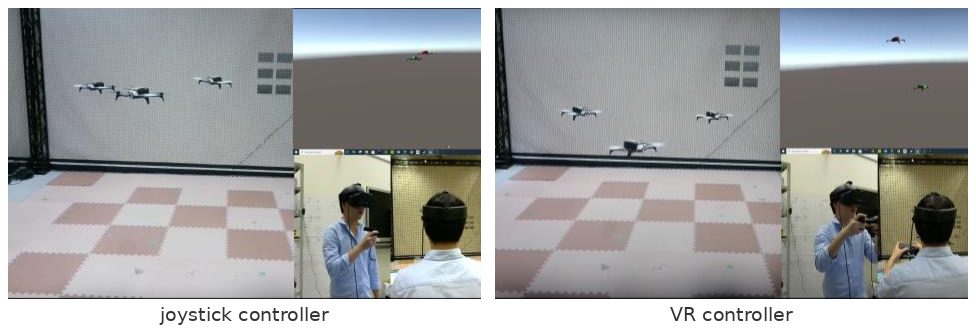
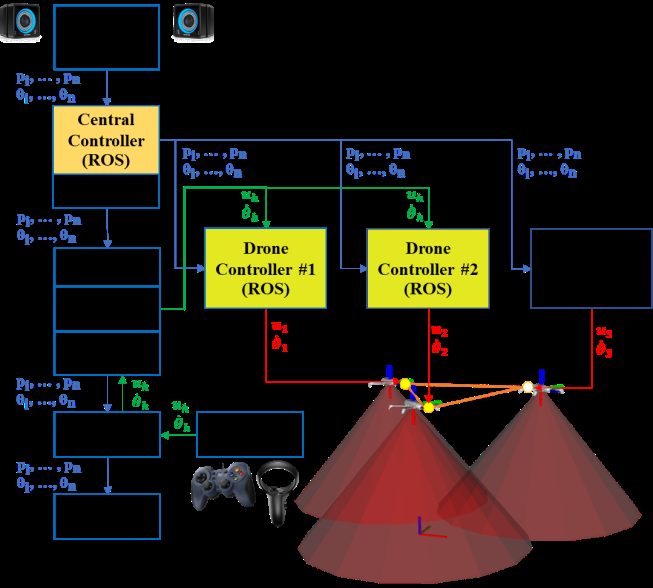
Three drones in a motion-capture room. Only two are reachable by the operator; the third has no direct input at all and has to keep station from its neighbours alone — which is the realistic case, since in the field an operator may never have had a link to every drone, or may lose one mid-flight.
Formation is held by PI-consensus control on position and P-consensus on orientation, with a control barrier function enforcing collision avoidance and workspace limits. Common orientation matters more than it sounds: without it, “forward” means something different to every drone and the operator cannot give a velocity command at all.
What was measured
Operators steered the swarm toward a goal pose regenerated every 20 seconds, seeing only the average position of the reachable drones. Five participants, none of whom had used the system before, ran both interfaces and filled in a NASA-TLX questionnaire after each.
| VR controller | Joystick | |
|---|---|---|
| Overall workload | 62.67 ± 30.29 | 29.67 ± 12.00 |
| Mental demand | 279.00 | 140.00 |
| Frustration | 192.00 | 24.00 |
| Physical demand | 62.00 | 6.00 |
The VR controller produced visibly smoother input — a joystick operator tends to slam the stick to ±1, and altitude was on a button, so it could only ever be full up or full down. Smoother, and roughly twice the workload.
Why
Two concrete reasons, both mechanical rather than perceptual:
Stopping is hard. Releasing a joystick stops the swarm. A VR controller has to be carried back to its reference pose and held there, so standing still is an active task.
The axes are coupled. An arm pivots at the shoulder, so moving along one axis drags the others with it. Isolating a single axis fights the geometry of the human body.
The proposed fixes follow from those causes: draw the reference point in the headset so it can be found again, add a dead zone around it, and show a guidance line for efficient arm movement.
With n = 5 and no experienced operators this is a preliminary observation, not a verdict on VR interfaces — but it is a useful reminder that an interface can be more intuitive and more expensive to use at the same time.