Solar Energy, 2023
Predictive Receding-Horizon Multi-Robot Task Allocation Applied to the Mapping of Direct Normal Irradiance in a Thermosolar Power Plant
Part of Predictive Multi-Robot Task Allocation for Radiation Monitoring
@article{martin2023predictive,
  title   = {Predictive receding-horizon multi-robot task allocation applied to the mapping of direct normal irradiance in a thermosolar power plant},
  author  = {Martin, Javier G. and Hanif, Muhammad and Hatanaka, Takeshi and Maestre, Jose M. and Camacho, Eduardo F.},
  journal = {Solar Energy},
  volume  = {263},
  pages   = {111911},
  year    = {2023}
}
A parabolic-trough solar plant runs heat transfer fluid through long loops of collectors, and the fluid temperature has to stay inside a band — too cold and performance drops, too hot and you get maintenance failures. Control acts on the flow. But when a cloud shades part of the field, the irradiance is no longer uniform, and controlling each loop’s flow independently needs a spatial map of irradiance across the plant — plus a prediction of where the shadow goes next.
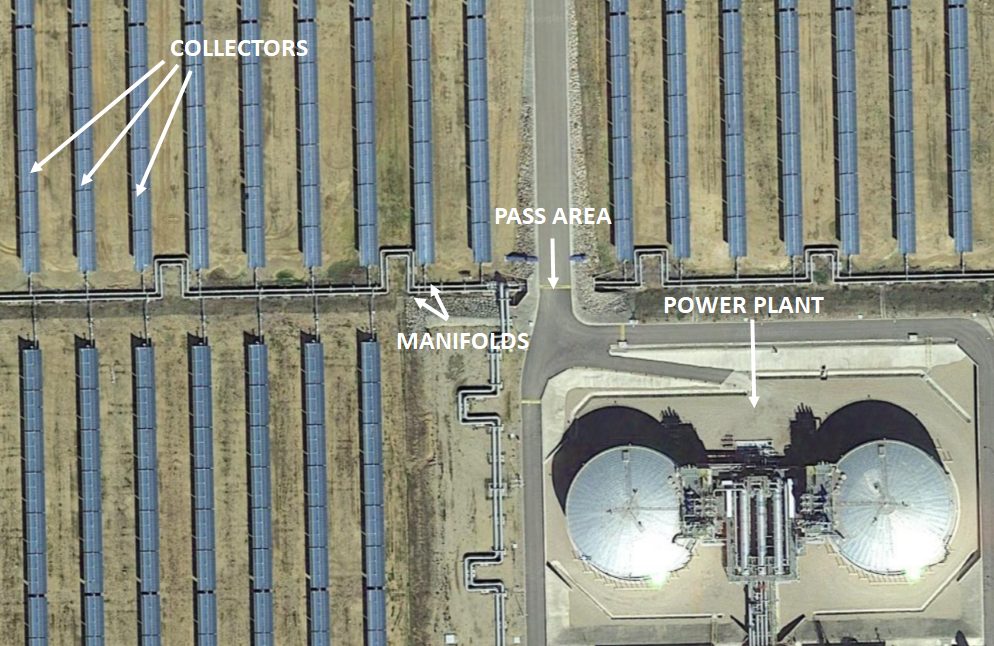
Pyrheliometers are too expensive to scatter across a solar field as a fixed grid. A robotic sensor network gets the same map for far less capital — and unlike a fixed grid it can sample only the shaded areas, since unshaded irradiance is essentially uniform. The paper’s own estimate: one UAV at 20 m/s on a 60 s sampling cycle is roughly equivalent to a grid covering 800 × 600 m with a sensor every 200 m. Getting that map is worth 6–12% more energy on cloudy days.
Which turns the problem into task allocation — except the tasks are clouds, and clouds move.
Approach
The measurement points are the tasks; the UAVs and UGVs are the robots; each robot does one task at a time and each task needs one robot. Because the tasks move, the allocation has to be time-extended: allocate a sequence over a horizon, apply only the first step, then recompute. Model predictive control, applied to assignment.
The cost balances distance travelled against task completion time — a per-robot penalty on distance, weighing battery and wear, against a per-task weight on how long it takes, weighing how much that cloud matters.
The central difficulty is that predicting where a robot will be depends on the allocation you have not made yet. An earlier version sidestepped this by assuming robots move toward the tasks’ centre of gravity. This paper instead estimates each task’s future position, computes robot-to-task interception points given known velocities, and averages the distances over which task was done previously.
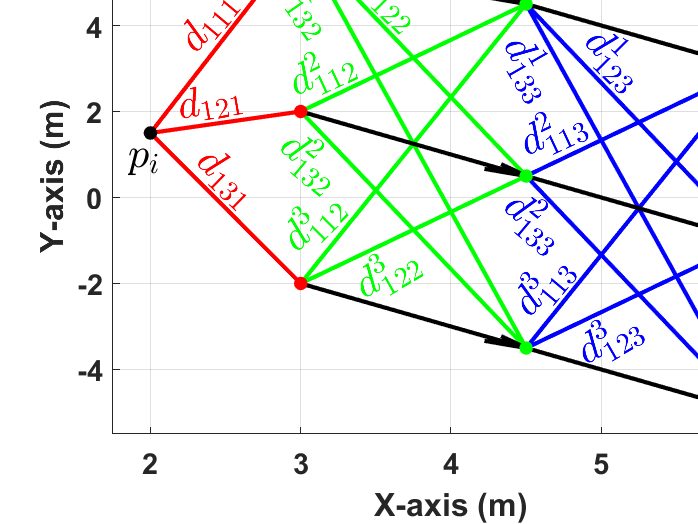
The point of all this is that the whole thing collapses into a linear program. Comparable time-extended MRTA methods solve a non-convex problem; an LP scales to plant-sized instances.
Recomputation is hybrid: event-triggered whenever a task completes, and synchronous on a timer, so drift in the cloud-velocity estimate gets corrected without waiting for a completion.
Results
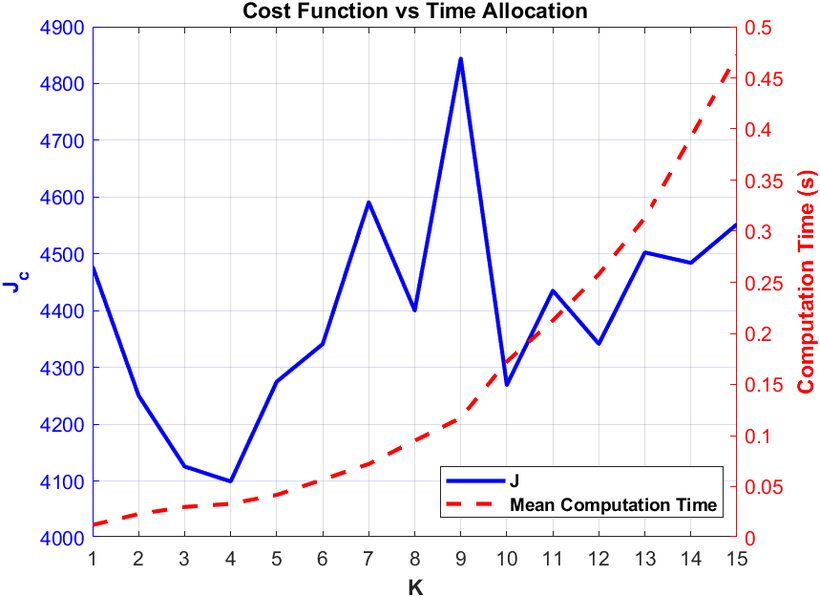
Horizon length. Across 1000 random problems, K = 3 or 4 is best. Longer is not better — the LP transformation rests on approximations whose accuracy decays along the horizon, and the underlying problem is strongly nonlinear.
Against a genetic algorithm. At K = 4, PMRTA solved 828 of 1000 problems against the GA’s 596. Of the 574 both could solve, PMRTA won 709 times and the GA 118. Overall the paper reports 38.92% more problems solved and a win in 85.73% of cases where both produced an answer.
Recomputation period. Shorter is not automatically better, but the hybrid strategy beats event-triggered alone — including when cloud velocity carries Gaussian noise.
Task direction. Performance degrades when tasks move in different directions, which is a limitation with a convenient property: cloud motion is wind-driven, so real clouds do move together.
ROS/Gazebo
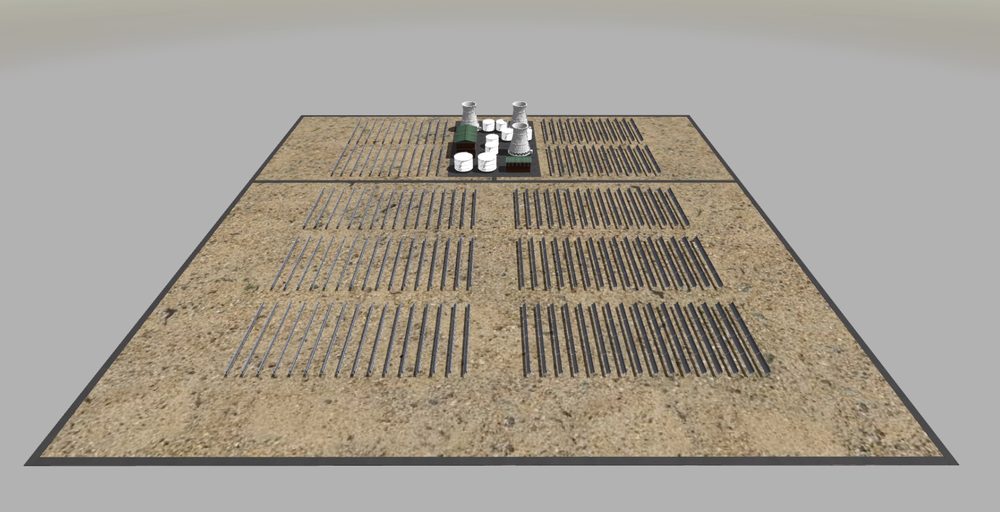
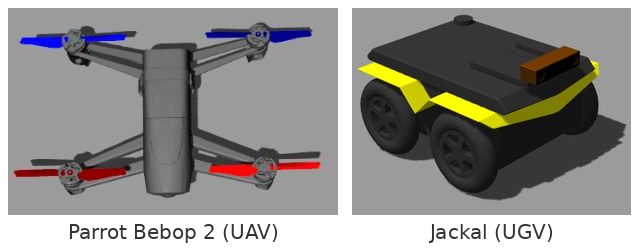
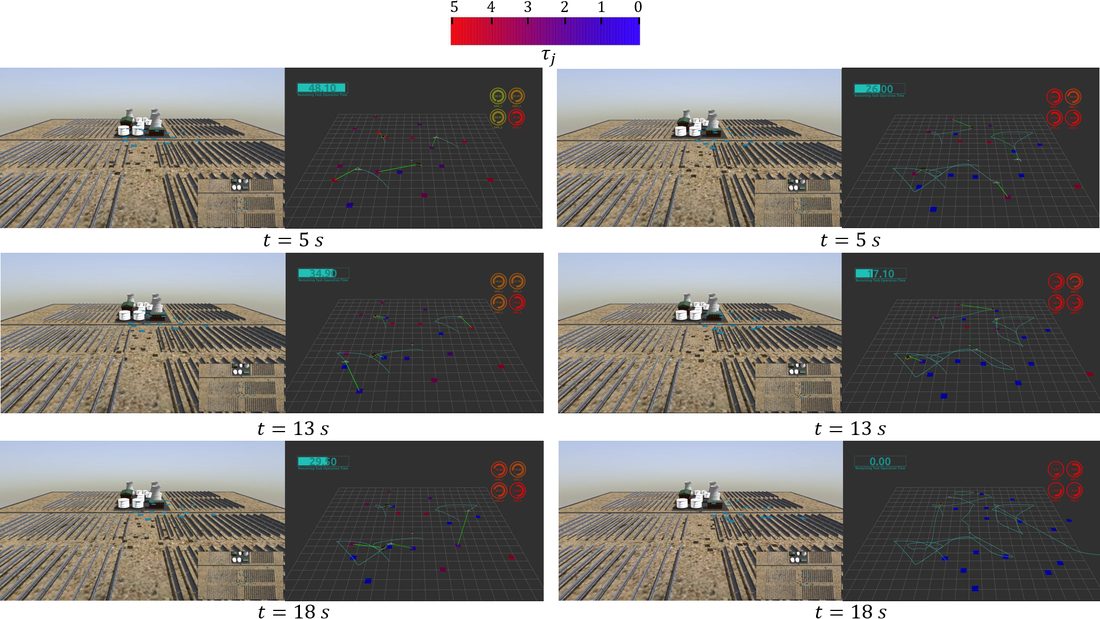
The realistic simulation reproduces the Matlab finding exactly — K = 3 and K = 4 remain optimal — with obstacle avoidance, battery dynamics and collision models all in play.
Limitations
The allocation is centralised; distributing it via ADMM is named as future work, as is choosing the robot count for a given plant size. Everything here is simulation — no real robots yet.
Funded by the ERC project OCONTSOLAR (grant 789051) under Horizon 2020.