Predictive Multi-Robot Task Allocation for Radiation Monitoring
UAV and UGV teams dispatched across a thermosolar plant to map direct normal irradiance, with a receding-horizon allocation that anticipates where measurements will matter next.
In collaboration with University of Seville

A parabolic-trough solar plant heats fluid by running it through long loops of collectors, and that fluid has to stay inside a temperature band — too cold costs performance, too hot causes failures. The control system manages flow to hold it there. That works while irradiance is uniform. Put a cloud over part of the field and it is not, and holding each loop at temperature needs a map of irradiance across the plant, plus a forecast of where the shadow is heading.
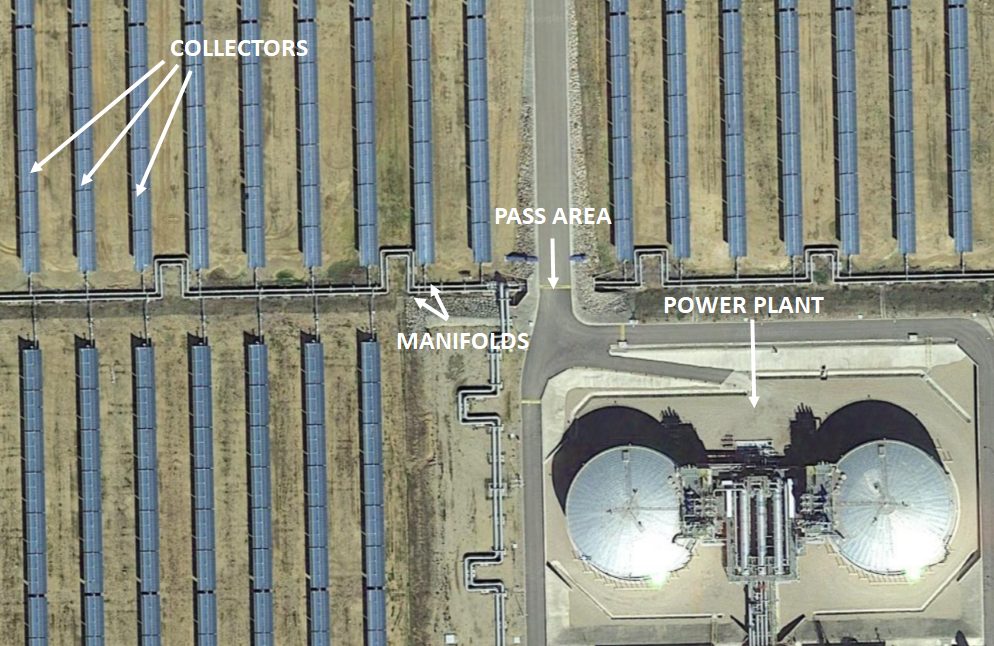
Pyrheliometers cost too much to scatter across a solar field as a fixed grid. A robotic sensor network buys the same map for far less — and it can sample only the shaded areas, where a fixed grid would spend most of its sensors measuring uniform, unshaded irradiance. One UAV at 20 m/s on a 60 s cycle covers roughly what a grid over 800 × 600 m with a sensor every 200 m would. The map is worth 6–12% more energy on cloudy days.
Which makes it a task allocation problem where the tasks are clouds, and clouds move.
The method
Measurement points are the tasks, UAVs and UGVs are the robots, one robot per task at a time. Because the tasks move, the allocation has to be time-extended — and the way to do that is to borrow the shape of model predictive control: predict how the tasks evolve, allocate a sequence over a horizon, apply only the first step, recompute.
The hard part is that predicting where a robot will be depends on the allocation you have not chosen yet. The method estimates each task’s future position, computes robot-to-task interception points from known velocities, and averages over which task might have come before.
All of it reduces to a linear program, which is what makes it usable at plant scale. Comparable time-extended methods solve a non-convex problem and do not scale that far.
Results
Short horizons win. Across 1000 random problems the best cost comes at K = 3 or 4 — longer horizons degrade, because the approximations behind the LP lose accuracy the further ahead they reach.
Against a genetic algorithm baseline, the predictive method solved 38.92% more problems, and won in 85.73% of the cases where both found a solution.
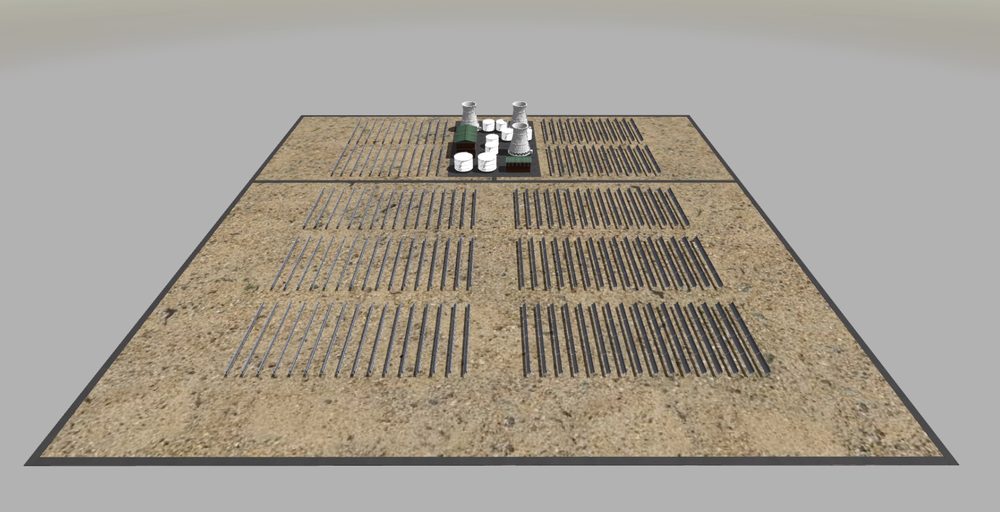
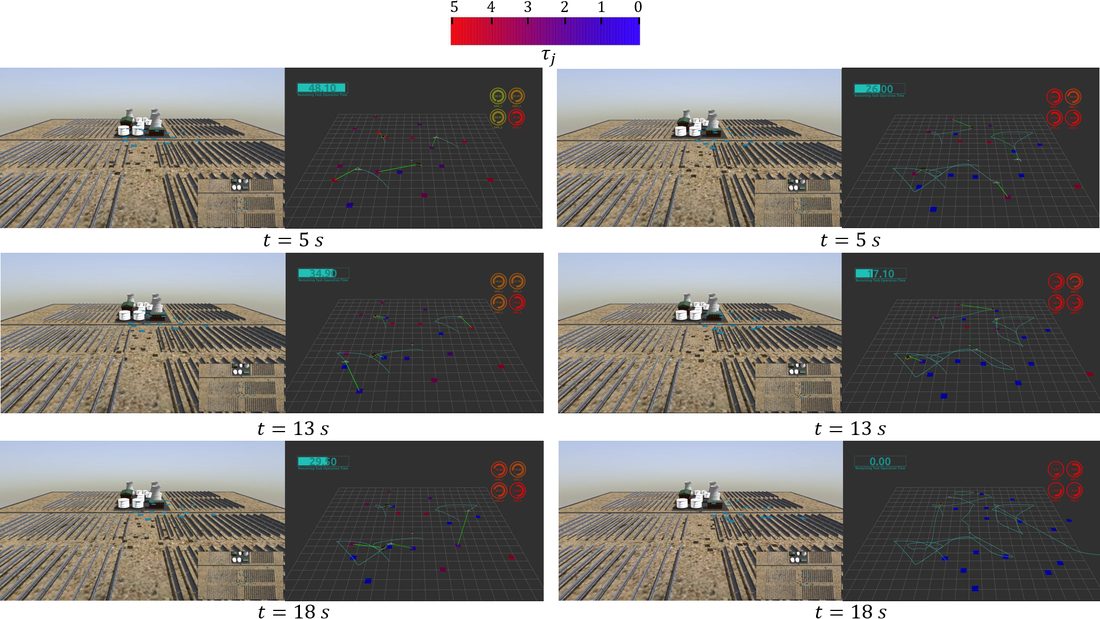
The ROS/Gazebo simulation — Parrot Bebop 2 UAVs at 4 m/s, Jackal UGVs at 2 m/s with laser-based obstacle avoidance, real battery dynamics — reproduces the Matlab result exactly.
One property is worth naming because it looks like a weakness and is not: performance drops when tasks move in different directions. Cloud motion is wind-driven, so on a real plant they move together.
Context
Work with the University of Seville under Prof. J. M. Maestre and Prof. E. F. Camacho, funded by the ERC project OCONTSOLAR. Published at ECC 2022 and extended in Solar Energy (2023); my M.Eng. thesis covers the related real-time multi-target allocation and tracking problem.
Publications from this project
Solar Energy, 2023
Predictive Receding-Horizon Multi-Robot Task Allocation Applied to the Mapping of Direct Normal Irradiance in a Thermosolar Power Plant
@article{martin2023predictive,
  title   = {Predictive receding-horizon multi-robot task allocation applied to the mapping of direct normal irradiance in a thermosolar power plant},
  author  = {Martin, Javier G. and Hanif, Muhammad and Hatanaka, Takeshi and Maestre, Jose M. and Camacho, Eduardo F.},
  journal = {Solar Energy},
  volume  = {263},
  pages   = {111911},
  year    = {2023}
}
European Control Conference (ECC), 2022
Predictive Receding-Horizon Multi-Robot Task Allocation with Moving Tasks
pp. 2030–2035.
@inproceedings{martin2022predictive,
  title     = {Predictive receding-horizon multi-robot task allocation with moving tasks},
  author    = {Martin, Javier G. and Hanif, Muhammad and Hatanaka, Takeshi and Maestre, Jose M. and Camacho, Eduardo F.},
  booktitle = {2022 European Control Conference (ECC)},
  pages     = {2030--2035},
  year      = {2022},
  publisher = {IEEE}
}
M.Eng. Thesis, Tokyo Institute of Technology, 2022
Real-Time Optimization for Dynamic Multiple Target Allocation and Tracking with Heterogeneous Robotic Systems
Department of Systems and Control Engineering.