SICE Journal of Control, Measurement, and System Integration, 2024
Angle-Aware Coverage with Camera Rotational Motion Control
pp. 211–221. Open access. Preprint arXiv:2404.13915.
Part of Angle-Aware Coverage Control for 3D Map Reconstruction
@article{lu2024anglewarecamera,
  title   = {Angle-Aware Coverage with Camera Rotational Motion Control},
  author  = {Lu, Zhiyuan and Hanif, Muhammad and Shimizu, Takumi and Hatanaka, Takeshi},
  journal = {SICE Journal of Control, Measurement, and System Integration},
  volume  = {17},
  number  = {1},
  pages   = {211--221},
  year    = {2024},
  doi     = {10.1080/18824889.2024.2351637}
}
Angle-aware coverage control asks drones to observe every point of a scene from many directions. But in the original formulation the cameras point straight down and never move — the only way to change the viewing angle is to fly somewhere else. That leaves the easiest degree of freedom on the table.
This paper puts the camera on a gimbal and controls it.
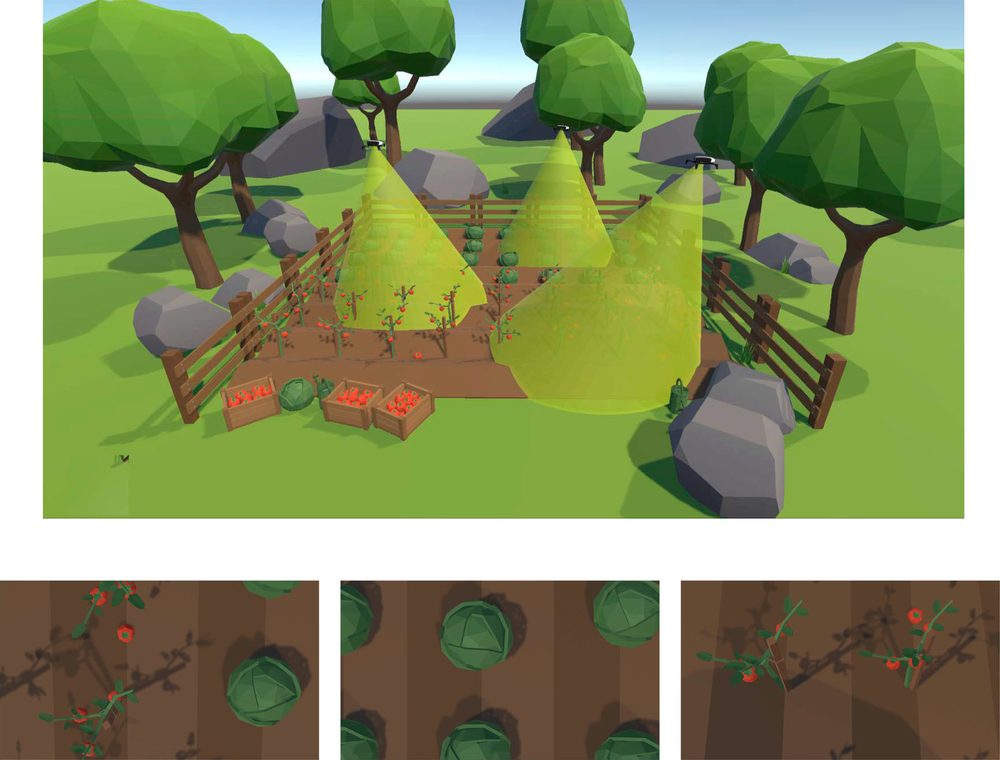
What changes
Each drone now carries a four-dimensional state: two position coordinates plus the gimbal’s horizontal and vertical angles. That needs a new performance function, because covering a point is now two conditions rather than one — the point has to fall inside the camera’s field of view, and the direction the drone sees it from has to match the viewing angle that point still needs. A QP-based controller with a control-barrier-like function then constrains the decay rate of the objective, with a second barrier keeping the gimbal pitch inside its mechanical limits.
The cost of doing this
Adding camera orientation makes the problem far more expensive than translation alone. In the original work the drone position that observes a point from a given angle was uniquely determined, which let the five-dimensional field collapse onto a two-dimensional one. With a steerable camera that mapping no longer exists, so the full 5D field has to be handled directly — and the gradient computation across all four state variables dominates the runtime.
The answer here is engineering rather than approximation: JAX, with JIT compilation and GPU acceleration.
| Central controller | Drone controller | |
|---|---|---|
| NumPy on CPU | 212 ms | 1206 ms |
| JIT, CPU | 31 ms | 102 ms |
| JIT, GPU | 6 ms | 22 ms |
Over a second per step is not a controller. At 22 ms it runs at roughly 10 Hz, which is.
Results
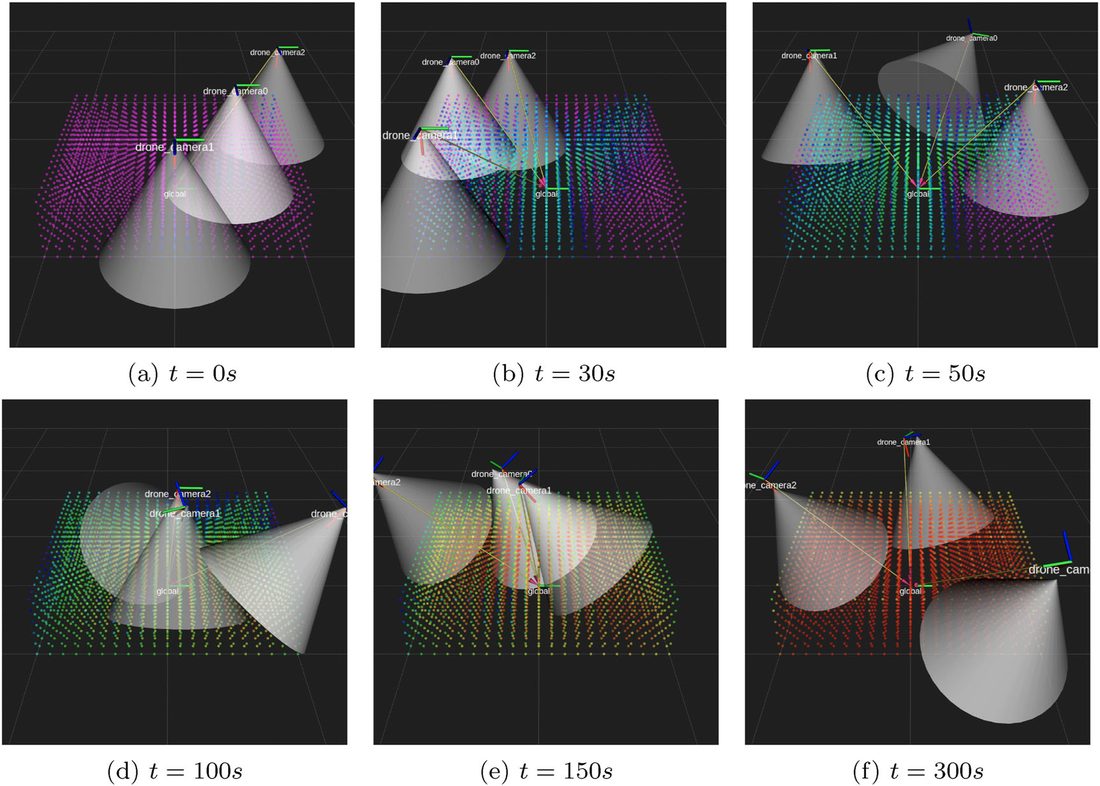
That late-stage behaviour — leaving the target area and looking back at it obliquely — is exactly what a fixed downward camera cannot do.
Comparing against the original controller needs care, since the two optimise different objective functions and neither objective is a fair yardstick. So the paper counts something physical instead: simulate photography at 5 Hz, and mark a point covered when it falls in frame and is seen from within π/16 of a direction it still needs.
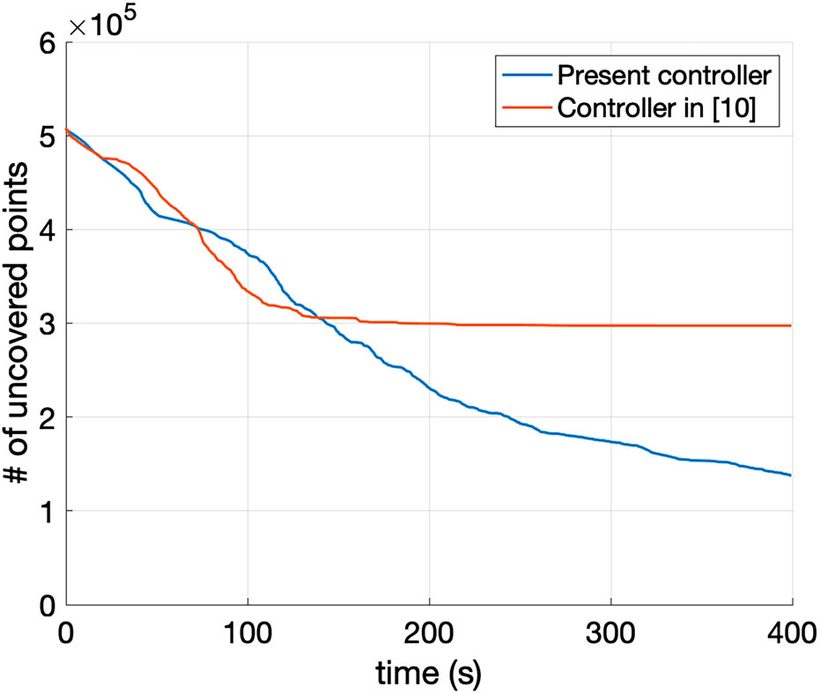
The paper is simulation only; hardware experiments and a comparison in terms of reconstructed 3D accuracy are left as future work.