SICE Annual Conference, 2024
Real-time Adaptation of Drone Altitude and Object Detection Model for Moving Target Tracking
pp. 533–538.
Part of Drone Coverage Control for Moving Target Tracking
@inproceedings{hanif2024realtime,
  title     = {Real-time Adaptation of Drone Altitude and Object Detection Model for Moving Target Tracking},
  author    = {Hanif, Muhammad and Hatanaka, Takeshi},
  booktitle = {Proceedings of the SICE Annual Conference},
  pages     = {533--538},
  year      = {2024}
}
Persistent coverage control lets a drone patrol a field and keep watch on a target it finds there. Earlier work handled this with control barrier functions — one constraint keeping coverage of the field above a performance level, another keeping a detected target inside the drone’s sensing range. It works, but only because the target is assumed to stand still.
Move the target and the assumption breaks.
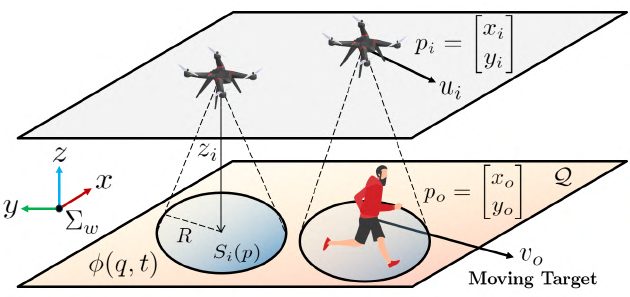
Three things that decide whether tracking survives
Target speed is the obvious one — computation and motion delays eventually lose a fast target. The other two are the interesting part, because they pull against each other:
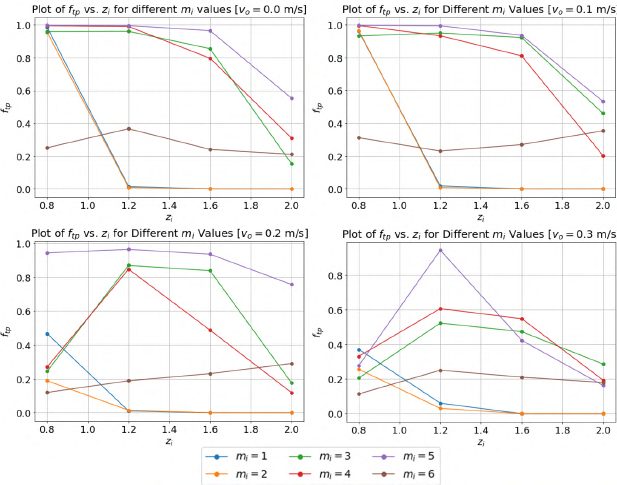
Detection model. Six TensorFlow detectors were tested, from MobileNet V1 (30 ms, 21 mAP) to Faster R-CNN Inception ResNet V2 (620 ms, 37 mAP). Accuracy and latency trade directly, and the most accurate model is not the best tracker — its latency loses the target anyway.
Altitude. Higher widens the field of view, so the target is less likely to slip out of frame. Higher also shrinks the target in pixels, which hurts detection. The right altitude therefore depends on which detector is running, and vice versa.
Adaptation
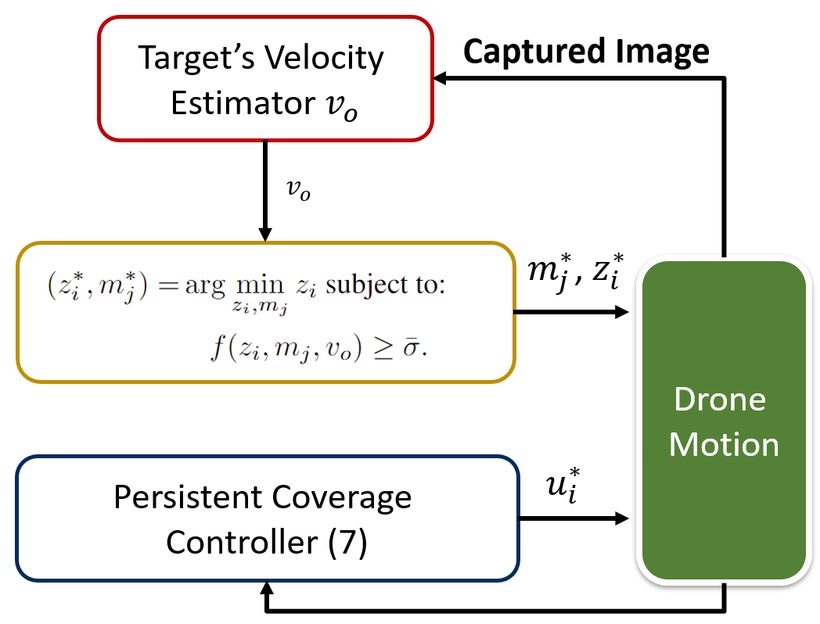
Since those 96 measurements map each (altitude, model, target speed) triple to a tracking score, the choice at runtime becomes a small discrete optimisation over 4 × 6 = 24 options: estimate the target’s velocity, then pick the lowest altitude whose configuration still clears a performance threshold. Lowest, because a lower altitude gives more pixels on target — useful for whatever recognition or decision comes after tracking.
Experiment
Flown on the Tokyo Tech Robot Zoo Sky testbed against a Scamper O-308 ground robot carrying an A3-size printed car, accelerating from 0.1 to 0.3 m/s over about two minutes.
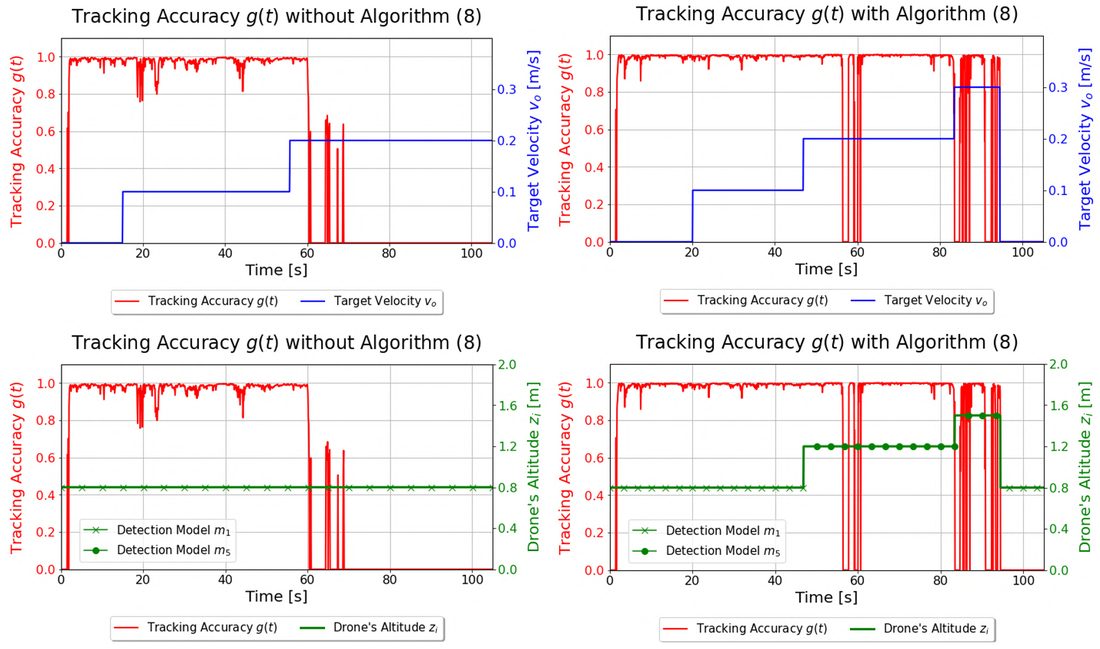
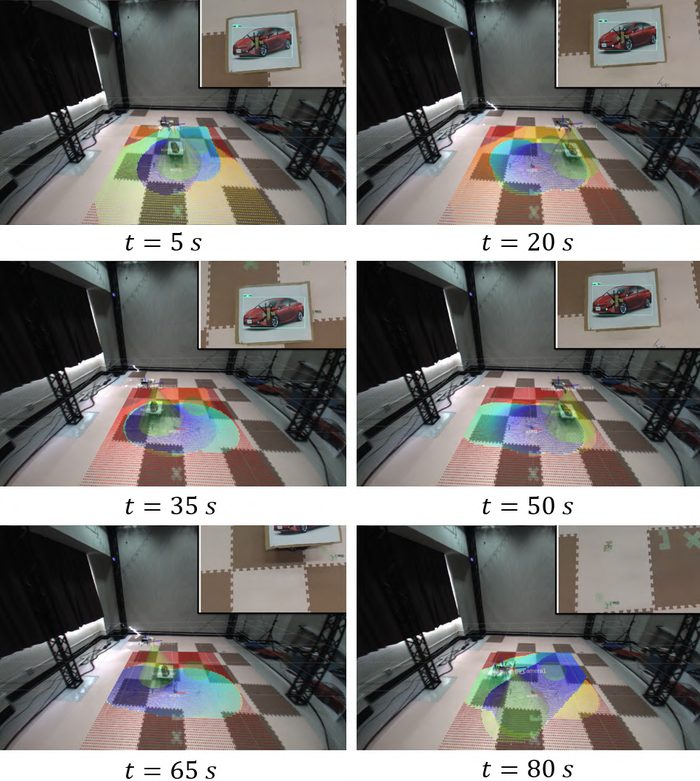
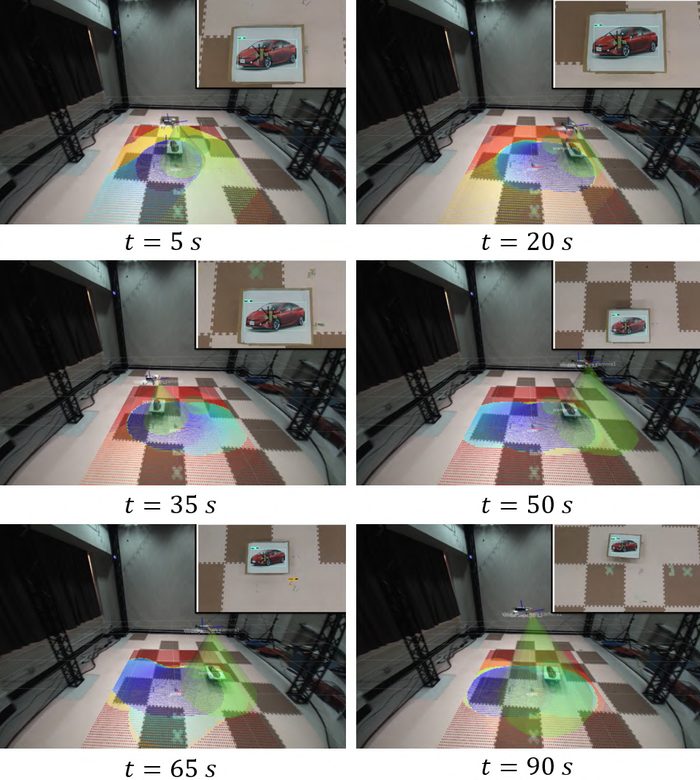
The altitude set is discretised here, and target speed is sampled at four values. Extending both to continuous ranges is the stated next step.
Carried out with support from Fujitsu Limited.