Drone Coverage Control for Moving Target Tracking
Adapting a drone's altitude and its object-detection model in real time, so detection accuracy and field of view stay matched to how the target is moving.
In collaboration with Fujitsu

Persistent coverage control can send a drone to patrol a field and hold watch on whatever it finds there. Earlier work in the group did exactly that, with control barrier functions keeping coverage above a performance level and keeping a detected target inside sensing range. It works — as long as the target stays still.
This project, in collaboration with Fujitsu, is about what breaks when it moves.
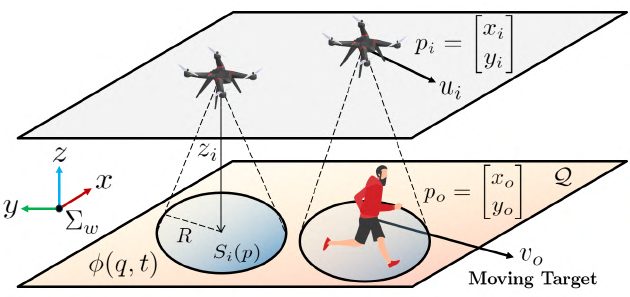
The trade-off
Fly low and the detector is accurate but the field of view is narrow, so a moving target slips out of frame. Fly high and the drone sees everything but the target is too few pixels to detect reliably. The right altitude therefore depends on which detection model is running — and the models trade accuracy against latency, from MobileNet V1 at 30 ms to Faster R-CNN Inception ResNet V2 at 620 ms.
The most accurate model is not the best tracker. Its latency loses the target regardless of altitude.
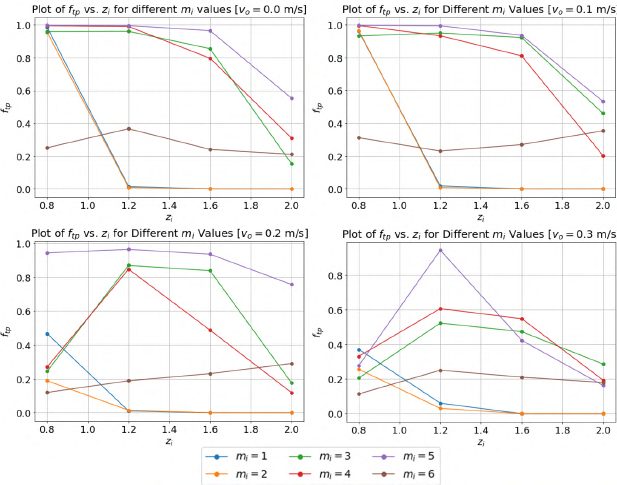
Adaptation
Those measurements turn the runtime decision into a small discrete optimisation over 24 configurations: estimate the target’s velocity, then choose the lowest altitude whose model still clears a performance threshold. Lowest, because more pixels on target helps whatever recognition comes next.
Implemented in ROS with TensorFlow detectors and flown on the Tokyo Tech Robot Zoo Sky testbed against a ground robot accelerating from 0.1 to 0.3 m/s. Without adaptation the drone loses the target the moment it reaches 0.2 m/s; with adaptation it climbs, switches to a heavier detector, and holds tracking accuracy near 1.
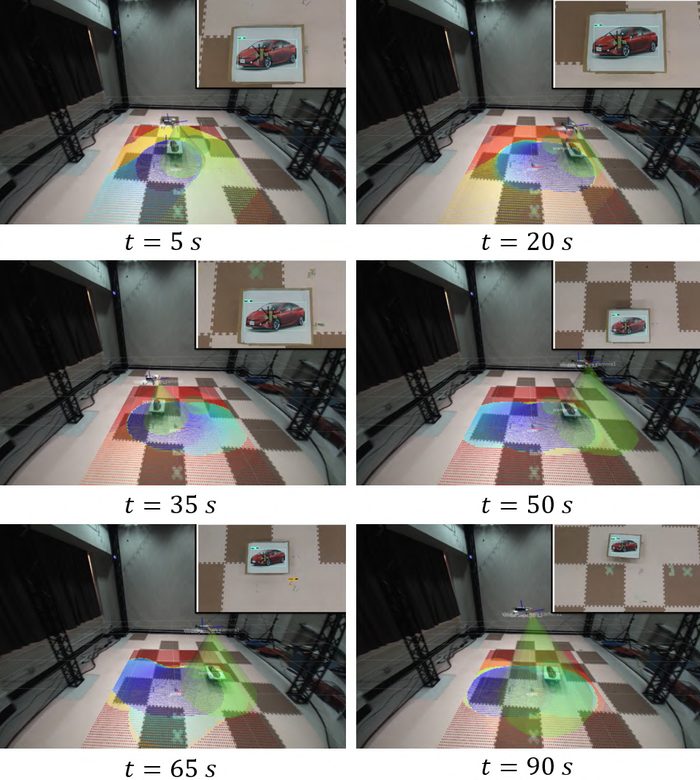
Presented at the SICE Annual Conference 2024 in Kochi, Japan.
Publications from this project
SICE Annual Conference, 2024
Real-time Adaptation of Drone Altitude and Object Detection Model for Moving Target Tracking
pp. 533–538.
@inproceedings{hanif2024realtime,
  title     = {Real-time Adaptation of Drone Altitude and Object Detection Model for Moving Target Tracking},
  author    = {Hanif, Muhammad and Hatanaka, Takeshi},
  booktitle = {Proceedings of the SICE Annual Conference},
  pages     = {533--538},
  year      = {2024}
}
M.Eng. Thesis, Tokyo Institute of Technology, 2022
Real-Time Optimization for Dynamic Multiple Target Allocation and Tracking with Heterogeneous Robotic Systems
Department of Systems and Control Engineering.