SICE Annual Conference, 2024
Angle-Aware Full 3D Coverage Control with ADMM-based Dynamic Assignment of Charging Stations
pp. 1119–1124.
Part of Angle-Aware Coverage Control for 3D Map Reconstruction
@inproceedings{lu2024admm,
  title     = {Angle-Aware Full 3D Coverage Control with ADMM-based Dynamic Assignment of Charging Stations},
  author    = {Lu, Zhiyuan and Hanif, Muhammad and Hatanaka, Takeshi},
  booktitle = {Proceedings of the SICE Annual Conference},
  pages     = {1119--1124},
  year      = {2024}
}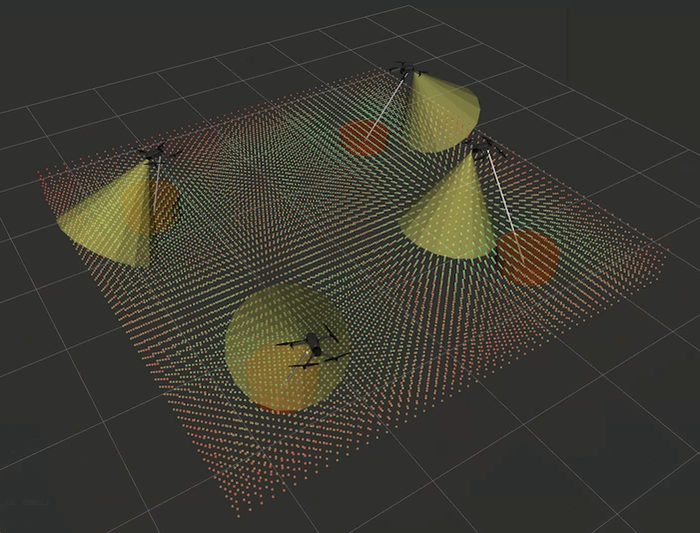
Angle-aware coverage control assumes the drones stay in the air. Batteries say otherwise: a field large enough to be worth reconstructing takes longer to cover than a drone can fly, so charging has to be part of the control problem rather than an interruption to it.
Enforcing a charging constraint is not new. What hurts is which station a drone returns to. Fix the drone-to-station pairing in advance and a drone can end up flying the length of the field to reach “its” station, wasting exactly the flight time the constraint was meant to protect.
Approach
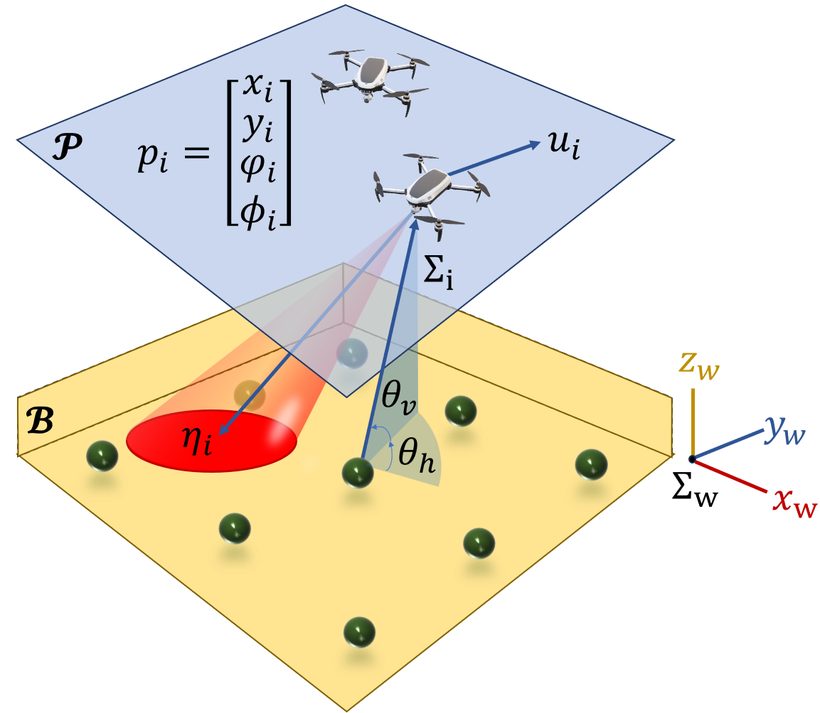
This paper assigns stations dynamically, through the alternating direction method of multipliers (ADMM), and folds that assignment into the constraint-based controller from the camera-rotation work. The QP each drone solves carries four barrier constraints at once:
- coverage performance — the decay rate of the objective stays above γ/n
- battery — the drone can always still reach its assigned station
- gimbal pitch stays within its mechanical limits
- no collision with the nearest drone
Each has a slack variable, so the problem stays feasible even when the specifications conflict.
Simulation
Built on ROS 2 Humble with JAX for JIT compilation and GPU acceleration, four drones modelled on the DJI Mavic 3E, four charging stations, and takeoff/landing delays added to make the simulator honest about the cost of going down to charge.
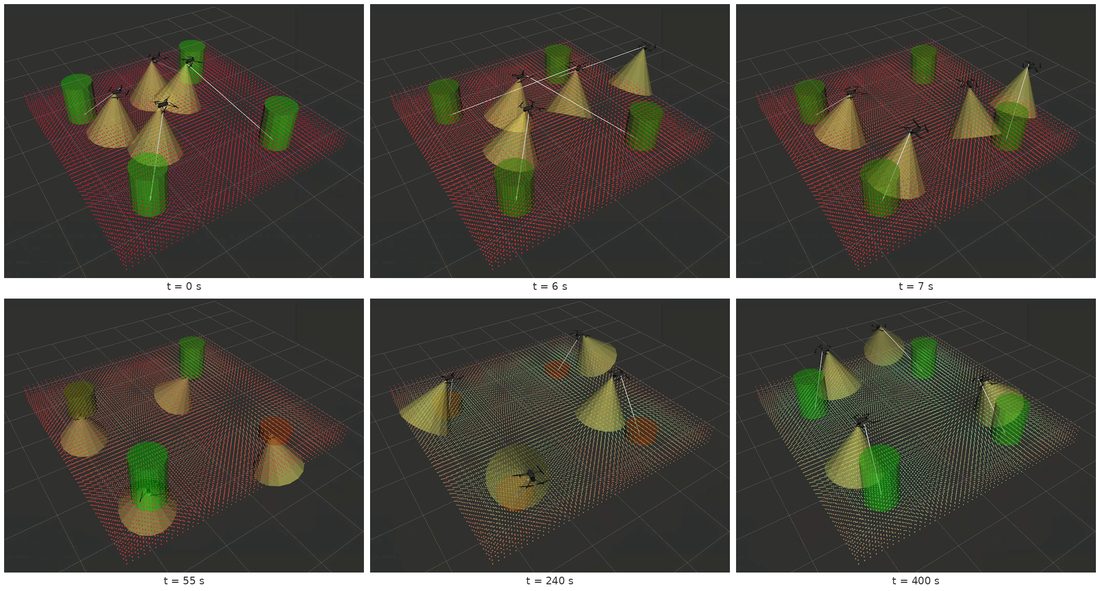
Against a fixed one-to-one assignment, the dynamic version drives the coverage objective down faster, for the reason it was designed to: nobody crosses the field to charge.